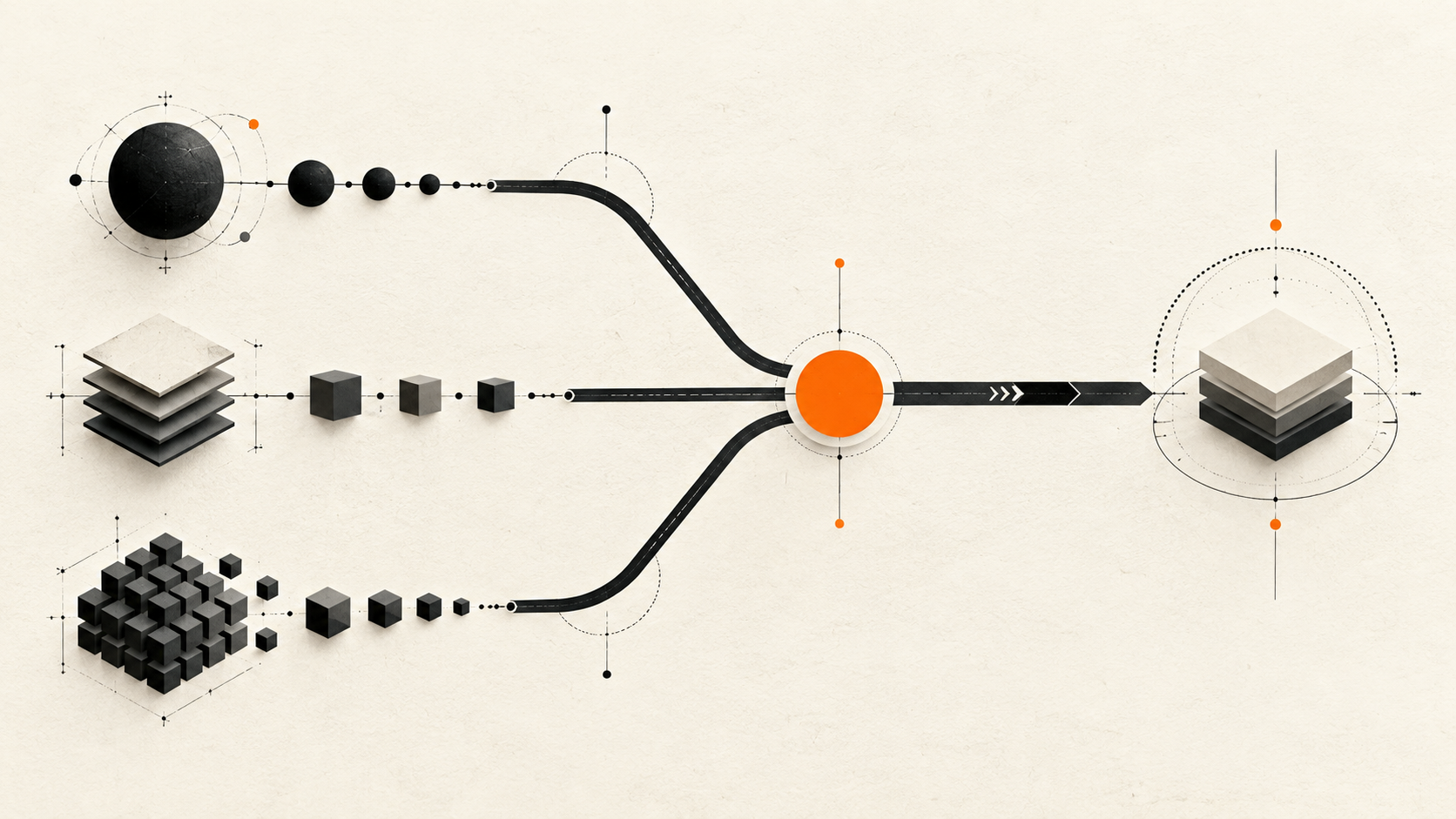
A model strategy is an operating decision: assign the right level of capability to the work, then measure accepted output.
Short answer: do not choose an AI model because it won a headline, topped one vendor chart, or sounds like the newest frontier release. Build a small portfolio around three jobs: frontier work that is expensive or hard to decompose, everyday production work that needs reliable throughput, and high-volume work where unit economics and controls matter. For many teams, GPT-5.6 Terra and Claude Sonnet 5 are the first daily-production candidates to evaluate; GPT-6 Astra and Claude Fable 5.1 are candidates for genuinely demanding, long-running work; Gemini 3.8 Flash and DeepSeek V4 models widen the test set when their documented capabilities fit the workflow.
That is not a universal ranking. Model releases, prices, context limits, safety policies, and tool support change. This guide uses provider documentation as a starting point and keeps the decision anchored in work a business can inspect. It does not guarantee a better result, lower cost, ranking, or a particular outcome from any provider.
Start with the job, not the leaderboard
The phrase “best AI model” hides the question that matters: best for what, under which controls, at what cost of review? A marketing team drafting a first-pass brief, an engineer tracing a multi-repository regression, and an operations team classifying thousands of routine requests do not have the same failure modes.
Start by naming the unit of work. It might be a qualified website-content review, a structured proposal outline, a support-triage decision, a code change with tests, or an internal research synthesis. Then record the information the model may access, the tools it is allowed to use, the reviewer who accepts or rejects the result, and the harm if it is wrong.
This produces a more useful choice than a generic benchmark table. A model with excellent long-context behavior may be unnecessary for a tightly scoped request. A low-cost model may be excellent for extraction with deterministic checks but unsuitable for a recommendation that affects a client. A frontier model can be economically sensible when one accepted output replaces hours of rework, and wasteful when it is asked to summarize the same small template thousands of times.
| Decision field | Useful question |
|---|---|
| Outcome | What observable result should be delivered? |
| Inputs | Which documents, systems, or facts are allowed? |
| Constraints | What must never be invented, changed, or disclosed? |
| Tools | Is browsing, code execution, retrieval, or file access required? |
| Reviewer | Who can accept, revise, or reject the output? |
| Cost of failure | Is the consequence inconvenience, rework, a client error, or a security issue? |
| Measurement | Which completed and accepted unit tells us whether the choice helped? |
Without this specification, one team will compare a polished answer from a simple prompt with another model’s output on a much harder task and call the result a model ranking. The actual difference may be task ambiguity, missing context, unsafe permissions, or a weak acceptance standard.
Use a three-lane model portfolio
The cleanest operating model is not “one model for everything.” It is a small portfolio with explicit routing. The lanes are about the work, not about a permanent hierarchy among providers.
| Lane | Primary question | Typical work | Operating rule |
|---|---|---|---|
| Frontier | Is the task unusually hard or long-running? | difficult engineering, multi-step investigation, complex planning | Use only with a clear acceptance test and escalation path. |
| Daily production | Can the team get consistent, reviewed output at sensible cost and speed? | drafting, analysis, coding assistance, structured internal work | Make this the default test lane for repeatable work. |
| Value and volume | Can bounded work scale with deterministic checks and appropriate controls? | extraction, classification, transformation, routine first passes | Measure unit cost, failure rate, and fallback rate together. |
This keeps an organization from treating a frontier model as the default for every small task, or treating a value model as a shortcut around quality control. It also makes procurement more honest. A team can say, “we need a frontier escalation for this class of work,” instead of claiming that every workflow needs the most expensive model.
The lanes can share a common prompt and tool policy. They should not share an assumption that the same output quality is appropriate. A routine categorization pipeline may pass only when it follows a strict schema. A strategic analysis may need cited sources, uncertainty labels, and human judgment. The model choice follows that acceptance standard.
Frontier work: GPT-6 Astra and Claude Fable 5.1
GPT-6 Astra and Claude Fable 5.1 belong in a frontier evaluation when the task is difficult enough that a stronger reasoning or long-horizon agentic capability could change the cost of completion. OpenAI presents GPT-6 Astra as its flagship model for difficult end-to-end work in its model documentation. Anthropic presents Claude Fable for frontier work and long-running agentic tasks in its Claude Fable documentation.
Those descriptions establish what the providers intend the models to be used for. They are not proof that either will be superior on your approved workload. The meaningful comparison is a controlled set of tasks that includes the work your team actually struggles to complete.
For a frontier test, use tasks such as a multi-file change that must pass its existing tests; a research question where source quality and contradiction handling are scored; a complex workflow plan with explicit non-goals; or a document set that needs a traceable, human-reviewed synthesis. Avoid starting with a novelty prompt. It will tell you more about how entertaining the demo is than about whether the model earns a production role.
| Question | GPT-6 Astra candidate | Claude Fable 5.1 candidate | What to verify locally |
|---|---|---|---|
| Intended position | OpenAI’s flagship option for hardest end-to-end work | Anthropic’s frontier option for demanding longer-running work | Whether the task actually requires that tier |
| Agentic workflow | Evaluate within the permitted tool and review boundary | Evaluate within the permitted tool and review boundary | Stop behavior, tool accuracy, recovery, and audit trail |
| Long context | Use the documented allowance as a constraint, not a guarantee | Use the documented allowance as a constraint, not a guarantee | Retrieval quality, ignored constraints, and source confusion |
| Cost decision | Compare accepted work, not token price alone | Compare accepted work, not token price alone | Total tokens, retries, reviewer time, and rework |
OpenAI’s release material includes comparisons with competing systems. Anthropic publishes its own model documentation and system information. Treat vendor evaluations as context for forming a hypothesis, not universal proof. The dataset, tools, prompt design, model version, scoring rule, and stopping condition can all determine the outcome. The best use of a public benchmark is to identify a claim it suggests, then test that claim on a small internal set.
There is another reason not to route every task to this lane: frontier capability does not eliminate operational controls. A powerful model can misunderstand an instruction, call the wrong tool if permissions are loose, produce a plausible but unsupported explanation, or continue where it should stop. The test must include those failures. A good escalation policy says when to use a frontier candidate, when to return the task to a daily model, and when a human needs to take over.
Daily production: Terra, Sonnet, and Gemini
Most teams will derive more value from getting their daily lane right than from debating the top frontier release. Daily production is where recurring work happens: structured writing, analysis, code assistance, support preparation, content operations, and internal decision support. The model should be capable enough to reduce real work while being predictable enough to review, budget, and operate.
OpenAI positions GPT-5.6 Terra as a balance of intelligence and cost in its current model guide. Anthropic positions Claude Sonnet 5 as a practical agentic model in its Sonnet 5 announcement. Google positions Gemini 3.8 Flash for complex workflows and long-context use in its Gemini API documentation.
That suggests a practical evaluation order, not a verdict. Start with Terra and Sonnet for recurring work that needs reasoning and writing or coding support. Add Gemini 3.8 Flash when the workflow benefits from documented multimodal inputs, long context, connected Google tooling, or the tool surface the provider exposes. Keep the same evaluation pack across models where possible.
| Daily-work concern | GPT-5.6 Terra | Claude Sonnet 5 | Gemini 3.8 Flash |
|---|---|---|---|
| Sensible starting role | Balanced general production candidate | Agentic production candidate | Long-context and multimodal production candidate |
| What not to assume | That balance means best for every task | That agentic strength removes review | That context length guarantees correct use of every input |
| First test | Recurring structured work with review | The same work plus permitted tool steps | The same work plus representative file or multimodal inputs |
| Decision signal | Accepted output per total operating cost | Accepted output plus recoverable tool behavior | Accepted output with correct grounding and tool behavior |
“Terra and Sonnet are enough for daily work” is useful only when it means “enough candidates to test before adding needless complexity.” It should not mean that a team disables its evaluation habit, ignores another provider’s fit, or assumes all work is identical. A good daily lane makes the default simple while preserving an evidence-based exception path.
For example, a content team might use a daily candidate to produce a source map, a first draft, and a structured QA checklist. The output is accepted only after a reviewer checks source links, claims, and the conversion route. A development team might use the same lane for a bounded change only when tests, static analysis, and browser evidence can verify the result. In both cases, the system is more important than a dramatic prompt.
Gemini 3.8 Flash: test the workflow fit
Gemini 3.8 Flash deserves a distinct test rather than being treated as a generic “Google model” entry. Google documents a large context window, multimodal inputs, tool capabilities, and features that can matter for long documents or workflow-oriented tasks. The documentation also distinguishes stable and preview capabilities; that boundary matters for a business system.
Use a representative test pack. If the intended workflow reads a large source set, include documents of the real size and structure. If it needs image or video context, use approved non-sensitive examples. If it needs tool execution, give it the exact permissions and stop conditions allowed in production. Then score more than final prose: did it select the correct source, keep the required boundaries, make only allowed tool calls, and surface uncertainty when it lacked evidence?
Long context can be valuable, but it is not a substitute for information architecture. Sending every available document into a model can increase cost, bury key facts, and make review harder. A well-designed retrieval or source-selection step may outperform a larger context dump. This is why model selection and workflow design should be owned together.
An ecosystem fit is valuable only if the business can operate the permissions, logs, review process, and data retention that come with it. A useful proof is an end-to-end dry run on a permitted task, not a product-page assertion. The same standard applies to every provider.
Chinese models: capability, controls, and economics
Chinese-origin model families should not be reduced to a “cheap alternative” category. They are candidates when documented capabilities, deployment terms, privacy posture, latency, and cost make sense for a defined job. DeepSeek’s official API documentation currently lists V4 Flash and V4 Pro options and describes its available interfaces in the model listing. Its pricing documentation is the appropriate source for current price assumptions, rather than a copied chart that may already be stale.
DeepSeek V4 Flash and V4 Pro can be useful candidates for a bounded value lane, particularly where the business can measure schema compliance, source extraction accuracy, retry behavior, and total cost per accepted item. That is not an instruction to send sensitive data to any provider. Before a real test, document the data classification, provider terms, retention and training settings where applicable, access controls, regional requirements, and a human escalation route.
| Evaluation dimension | Why it matters for a value lane |
|---|---|
| Unit cost | Compare input, output, retries, and reviewer minutes per accepted item. |
| Schema reliability | A low-cost extraction is valuable only if it passes deterministic checks. |
| Language and domain fit | Test actual vocabulary, source formats, and customer context. |
| Tool behavior | Confirm that tool calls are permitted, observable, and safely bounded. |
| Privacy and procurement | Confirm intended data use is allowed before the pilot starts. |
| Fallback | Define what happens when the model fails a check or returns uncertainty. |
The market includes other Chinese and open-weight families. Add them only when there is a concrete business reason and a source-backed understanding of the version, hosting, data boundary, and evaluation. A long vendor list without a test harness is not a model strategy.
Price is an operating metric, not a shortcut
Token pricing is relevant, but it is not the total cost a business pays. A lower nominal price can become more expensive if the output needs more retries, more human repair, or a second model to correct it. A more capable model can become cheaper if it completes a hard task correctly with less review. The decision should use total cost per accepted unit of work.
accepted-unit cost = model usage + tool usage + retries + reviewer time + remediation cost
This formula prevents two common errors. The first is to celebrate a low price before accounting for correction work. The second is to approve a premium model based only on one impressive first output. In both cases, the missing variable is acceptance: did the result meet the defined standard without creating downstream work?
Pricing changes more frequently than an editorial article. For a procurement decision, return to the current provider price page, record the date, the model mode, the expected token mix, and relevant rate limits. Do not turn an old blog figure into a fixed budget promise.
Build an evaluation harness before rollout
An evaluation harness can be small. It does not need a research department. It needs representative tasks, a written scoring rule, a safe dataset, and a reviewer who can explain why an output passed or failed.
Start with 15 to 30 tasks from the intended workflow, split across easy, typical, and difficult examples. Remove or protect sensitive inputs. Freeze the scoring rubric before reading outputs. A rubric for content might score factual support, scope clarity, source quality, structure, and whether it avoids unsupported claims. A rubric for code might score tests, regression safety, correct tool use, and whether the change stays inside the requested scope.
Run the same prompts and tool permissions across candidates where practical. Record version identifiers, settings, prompt template, tool results, cost, elapsed time, retries, reviewer score, and failure reason. The output does not need to be public; it needs to be inspectable by the people approving the workflow.
| Outcome | What it means |
|---|---|
| Pass | The output met the rubric with expected review effort. |
| Repairable | The output was useful but required a known, bounded correction. |
| Unsafe | The output violated a boundary, invented support, or made an unauthorized action. |
| Inconclusive | The task or rubric was too vague to make a decision. Improve the test before choosing. |
This converts model selection from a preference debate into a testable operational decision. It also helps a team notice when the bottleneck is not the model. Poor source material, unclear ownership, missing tools, or an ambiguous acceptance standard can make every model look inconsistent.
Compare the system around the model
Model cards cannot tell you whether the operating system is sound. The most important quality controls sit around the model: source selection, permissions, tool boundaries, validation, logging, human review, and rollback.
For external research, require primary sources or label inference clearly. For content, require that material claims have inspectable support and that the final page has truthful scope. For tools, allow only the smallest permissions needed and make destructive actions require explicit approval. For code, keep the change bounded and let tests, types, builds, and a real browser review decide whether it is acceptable.
This is where an AI agents service becomes more useful than a generic chatbot promise. The work is not merely choosing a model name. It is designing the controlled path through information, decisions, tools, reviewers, and evidence. The related artificial intelligence service should be judged by the same criteria: what decision is supported, what evidence is available, and what stays under human control.
A sensible default stack for a small US business
For a small or medium business, start with fewer choices than the market offers. A practical default is one daily-production candidate, one approved alternative, and a frontier escalation only for work that earns it. Evaluate GPT-5.6 Terra and Claude Sonnet 5 on the daily jobs first. Include Gemini 3.8 Flash when its documented context, multimodal, or ecosystem capabilities match a real workflow. Add a DeepSeek V4 candidate for bounded, approved value work only after data and controls review. Keep GPT-6 Astra and Claude Fable 5.1 as frontier candidates for the small set of tasks whose complexity justifies that lane.
The choice becomes clearer when written as a policy:
- Use the daily lane for recurring work with a defined reviewer and measurable acceptance rule.
- Escalate to a frontier candidate only when the task exceeds the daily lane’s demonstrated boundary.
- Use the value lane only where deterministic checks and safe data handling make it appropriate.
- Stop and ask for human judgment whenever sources conflict, permissions are unclear, or the output would create an irreversible change.
- Re-run the evaluation after a material version, pricing, workflow, or policy change.
This policy is less exciting than a single-model declaration. It is more likely to survive the next release cycle. It also gives the team a way to explain why a model was selected without promoting a vendor as an absolute winner.
What this comparison does not prove
This guide does not prove that one provider will produce the best result for your company. It does not declare a permanent winner, recommend sending confidential data to a provider, or promise savings. It does not turn vendor benchmarks into a claim about a customer workflow.
What it does provide is a decision method: separate frontier, daily, and value work; use current primary documentation; score outcomes against the same acceptance criteria; and include the human effort required to make output safe and useful. When the question is how AI should improve a public website or service operation, begin with the business decision and evidence path, then choose the model that earns its role.
If you are designing an AI-assisted workflow around a real customer journey, talk to YAG US about requirements, data boundaries, and measurable output before selecting a production stack. If the first challenge is making the website clearer for people and AI search systems, start with Generative Engine Optimization and the page ownership, source, and measurement work underneath it.